Showing posts with label Fracking News PA. Show all posts

Sunday, December 22, 2013

PA Supreme Court Strikes Down Major Portions of Shale Drilling Law


Pennsylvania Supreme Court declared major provisions of the state’s Marcellus Shale drilling law, Act 13, unconstitutional Thursday, including one that allows gas companies to drill anywhere, overriding local zoning laws.

Thursday, December 5, 2013

Why Every Pennsylvanian Should Be Offended By the DEP

from an article in the Marcellus Monitor

Let me tell you why you should be offended by the Pennsylvania Department of Environmental Protection.

(And forgive me for starting with a bit of necessary background):

See, when I was at Patch, I broke a story about a local impoundment operated by Southpointe-based Marcellus Shale driller Range Resources in Cecil Township.

Local government officials there told me about a spate of issues they had with the Worstell impoundment in the wake of being notified by the DEP that Range wanted to make some major modifications there.

Wednesday, November 13, 2013

A fracking accident by Exxon results in negative environmental effects

by Toby Forstater The TEMPLE News
XTO Energy Inc., a subsidiary of the gas giant Exxon Mobil Corp., has recently been fined $100,000 for criminal violations and is forced to clean up a 2010 wastewater spill caused by hydraulic fracking in Lycoming County, Pa. Pennsylvania Attorney General Kathleen Kane’s office announced  Sept. 10 that the company will be prosecuted.
XTO is subject to three criminal counts under the Solid Waste Management Act and five counts of violating the Clean Streams Law.

Tuesday, October 22, 2013

Why did Cabot Oil and Gas demolish the former Sautner home on Carter Road, in Dimock, PA and who is the new buyer? Here’s the rest of the story:

Re-posted from A blog by Tom Wilber


When I last visited Carter Road, a contractor for Cabot Oil & Gas was demolishing the former home of Craig and Julie Sautner, the anti-fracking activists who had relinquished their three-bedroom ranch as part of a settlement with the Texas drilling company. This was part of a larger dilemma in their hometown of Dimock, Pennsylvania, where the Sautner’s water well was polluted by nearby Cabot drilling operations, according to records from the state Department of Environmental Protection. It’s a charge that Cabot has denied publically and settled privately – with the Sautners and dozens of other plaintiffs.

>>> Read More <<<

Monday, September 30, 2013

Marcellus Monthly for October 2013

"Marcellus Monthly"
is  a newsletter from
Marcellus Protest of Western Pennsylvania

You can download the latest monthly issue at


Monday, August 26, 2013

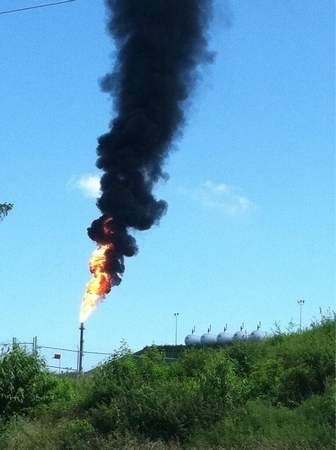
Latest MarkWest Flare Excursion has PA Residents Worried

MarkWest Cryogenic Plant Flare Pollution 
From an Article by Emily Petsko and Mike Jones, Washington (PA) Observer-Reporter, August 23, 2013

LOCATION:
PA Route 519 northwest of Houston,
Washington County, PA. 

People living near MarkWest’s natural gas processing plant in Chartiers Township are losing patience with the company after another flaring incident at the site on August 22, 2013.

Suzanne Bastien, who lives less than two miles from the MarkWest plant, said she saw black smoke billowing from the flaring tower from 11 a.m. to 7:30 p.m. on August 22nd, which she documented with her camera. Bastien said she and her husband have seen flaring there for four or five years, but the last two instances have been particularly bad.

“My eyes were burning, my throat was burning and I was nauseated when I got in the house. You could taste a metallic taste in your mouth,” Bastien said of the smoke from August 22nd. “It just kind of hung in the air, which made it even worse. I don’t necessarily want to be an activist, but this is getting to the point where we’re really worried about our health.”


Sunday, August 25, 2013

Aug. 28 webinar to examine water sales to shale-gas drilling companies

UNIVERSITY PARK, Pa. – Water use by the Marcellus Shale gas industry in Pennsylvania and West Virginia will be the subject of a Web-based seminar offered by Penn State Extension.
The session, from noon to 1 p.m. Wednesday, Aug. 28, will review what is known about the changing demand for and values associated with water used in shale-gas development and will feature related research findings.
The webinar will cover the findings of a recent study of
Pennsylvania and West Virginia public water suppliers
 that have sold water to shale-gas drilling companies.

Tuesday, August 13, 2013

According PA DEP’s own documents there have been at least 161 cases of groundwater contamination caused by oil and gas development between 2008 and the fall of 2012.


  1. This information became public through a Right-to-know Request filed by the Scranton Sunday Times. Why was this information withheld from the public and why did the DEP fight the request in court?

    Clearly, public agencies are hiding the dangers from the people of PA. The DEP has publicly denied any cases of groundwater contamination caused by oil and gas drilling in PA. Former secretary, Michael Krancer told the Federal Subcommittee on Water Resources and Environment “the myth that terrible chemicals are getting into the groundwater is completely myth. It is bogus.” 

Sunday, July 7, 2013

Why Vera Scroggins started watching Natural Gas Drillers


It takes people who are skeptical about the advance of industry to start sniffing around and find the dirt that convinces others how dangerous in. How long has it been since SILENT SPRING? Why do we still believe heavy industry when it promises it will keep us all "safe" as they destroy nature for profit? Hats off to Vera and her crew for fighting the frackers in Northeast PA.

Saturday, May 18, 2013

The Facts on Fracking | BillMoyers.com

by Julia Conley and John Light

Hydraulic fracturing or fracking — a method of extracting natural gas from underground shale formations — has become a contentious issue across America, especially in New York, Pennsylvania, West Virginia and Ohio, states that sit on top of the Marcellus Shale, the largest known deposit of shale gas in America. Some estimate that the shale formation could contain nearly 500 trillion cubic feet of gas — enough to power all American homes for 50 years. Oil and mining companies want to get the gas out, but environmentalist groups say the process is not safe. Here are the facts:

Friday, May 17, 2013

“The Department investigation indicates that gas well drilling has impacted your water supply.”


Despite the oft-repeated gas industry canard that there are no confirmed cases of fracking contaminating water supplies, the following Determination Letters from the Pennsylvania Department of Environmental Protection clearly state  that “gas well drilling” has contaminated wells in Bradford County, in municipalities such as Granville, Tuscarora, Terry, Orwell, Wilmot and Monroe Townships, and in Alba Boro.
The letters posted so far were obtained by Right to Know requests to the PA DEP filed by Vera Scroggins of “Citizens for Clean Water” located in Susquehanna County.

Wednesday, May 15, 2013

The Shale Gas Review: Frack Chemicals and Water Contamination

by S. TOM BOND on MAY 14, 2013


Commentary from Tom Wilber, The Shale Gas Review, May 10, 2013
The migration of fracking chemicals in the soil, in the earth’s strata and in groundwater are problems that are not fully understood. Plus, the chemicals resulting from drilling and fracking contain some toxic materials that have been leached from the earth or exposed by the drilling and frack operations. Tom Wilber in his blog entitled “Shale Gas Review” takes up these topics.

Tuesday, April 2, 2013

Organic Farmers Struggle to Protect Land from Encroaching Fracking Industry

EcoWatch

Many farmers in Pennsylvania welcomed the natural gas industry with open arms, letting companies set up operations on their land to drill wells and fracture the shale rock thousands of feet under the surface. Pennsylvania would not have become one of the top gas producing states in the U.S. in such a short period without the acquiescence of the state’s farming community.
Not every landowner, though, believed in the promise of riches or bought into the gas industry’s image of family farms coexisting with large-scale industrial activities. Among the skeptics were organic farmers, who feared the entire process of shale gas drilling—from the building of the well pads through the hydraulic fracturing process to the disposal of fracking wastewater—threatened their ability to produce products that conformed to organic standards.